
Ironsworn uses 3 dice to determine any outcome: one of them is a d6, two are d10.
Simply speaking, the d6 is you. Roll a d6 and add your stat (Edge/Heart/Iron/Shadow/Wits). That’s your total. Then, roll two d10 to determine the challenge.
Does your total beat none, one, or both of the d10s? (Ties do not count.)
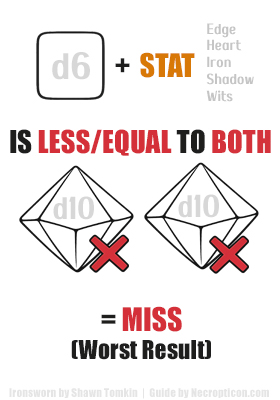
If your total is less than either of the two d10s, it’s a MISS.
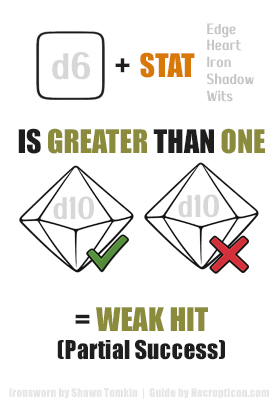
If your total is greater than one of the d10s, it’s a WEAK HIT.
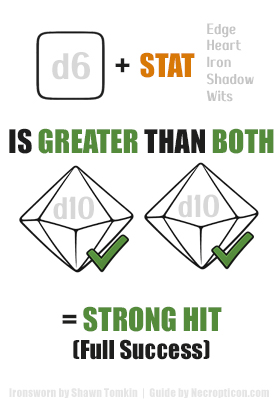
If your total is greater than both of the d10s, it’s a STRONG HIT.
The score can have additional bonuses from Assets or Moves. The maximum value, however, can never exceed 10 (which means it can never beat a “10” on a d10).
Action Dice vs. Challenge Dice
The d6 is referred to as the Action Die, and the [d6 + stat] total is called your Action Score. You will also hear the two d10s called the Challenge Dice.
There are a few mechanics in the game that can affect either of the two sides of this roll resolution.
- You can Burn Momentum to ignore challenge dice that are less than your Momentum value (and then set the Momentum to its reset value, +2 by default)
- (See How Momentum Works)
- If you are using the Starforged rule for burning Momentum instead, replace the Action Die (d6) with your current Momentum score
- Progress Moves use the current Progress Score (# of boxes completed) instead of your Action Score (you don’t roll the d6) against the two Challenge Dice.
- Neither positive, nor negative momentum can affect this roll.
- Some Moves use your Supplies or Health tracks as bonuses instead of your stat. A shared Bond with a community or an individual can add +1 on top of your Action Score.
Rolling Matches
There is narrative significance to rolling two matching d10s.
- Match and a Strong Hit (you beat both dice) introduces a twist in the narrative, something interesting, or a new opportunity.
- Match and a Miss (worst result) means a worse negative outcome, a complication, or a new danger.
Think about the result as extra, or an “and”.
However, you do not necessarily have to follow these exact suggestions. Players in the Ironsworn community have swapped in the scene change mechanic from Mythic GME, Plot Points from The Adventure Crafter, or custom random encounter tables for the Match resolutions with great results.
Remember: whenever you are not sure of what should happen, Ask the Oracle.
Miss and Pay the Price
Depending on the Move, consequences of roll outcomes will differ, but Miss most often instructs you to Pay the Price.
Tips:
- Keep in mind that narrative outcomes tend to be more interesting than mechanical ones.
- They can be just as or more severe for your character.
- Mechanical losses work well for repeated failure in a scene, and you can adapt more severe consequences for more dangerous tracks/enemies to increase the stakes (think about Position in Forged in the Dark system, for example).
This guide references and builds upon the rules and concepts from Ironsworn by Shawn Tomkin. Please see the official source materials for the complete game and full context.
Ironsworn Dice Resources
Dice Rollers
If you would like a way to automate dice rolling but don’t want a whole darn interface to come with it, here are a few minimal options:
- Perchance Ironsworn Dice Roller
- Ironsworn Assistant: Die Roller
- Chartopia Ironsworn Dice Roller
- Physical dice, anyone?
- And if you are looking for a universal digital die-roller, we highly recommend Sophie’s Dice.
Dedicated Interfaces
Ironsworn companions that include dice (and much more):
- Iron Journal: comparatively minimal interface with a surprising number of features (including custom Assets and map annotation).
- Pocketforge: comes with similar functionality but a more colorful interface.
- Ironsworn Companion: fullest feature interface without VTT features.
- The Augur: paid solution with VTT elements, overhead map random generation, dungeon map generation and annotation, NPC sheets, as well as AI accommodation.
Other
- Discord Ironsworn Bot: TheOracle: will not only roll the dice, but automatically count in the stats for all of your party’s characters, offer Moves & Rules reference, and create notes.